
Framer or Webflow, who wins in 2026?
Webflow wins the Framer vs Webflow duel in 2026. Comparison table, verified prices, and the choice by profile. No mercy.
Updated · 8 min read
The essentials in 30 seconds
- Framer: high-end design sites, AI generation and translation.
- Webflow: pro visual site builder, AI features added.
- Pricing: Webflow at $17/month, Framer higher at $9/month. Double that if you push it every day.
Verdict: Webflow, for the majority of use cases.
The comparison table
| Criteria | Framer | Webflow |
|---|---|---|
| Starting price | $9/month | $17/month |
| Business model | Freemium | Freemium |
| Catalog category | no-code | no-code |
| Target profile | Fast builder | Fast builder |
| Official site | framer.com | webflow.com |
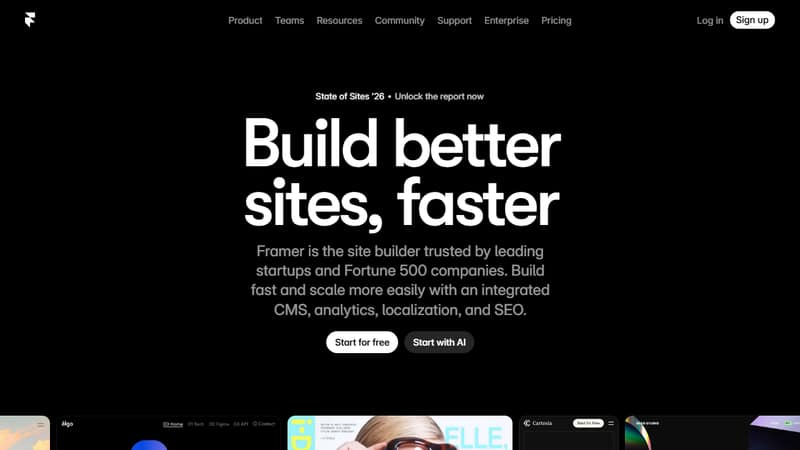
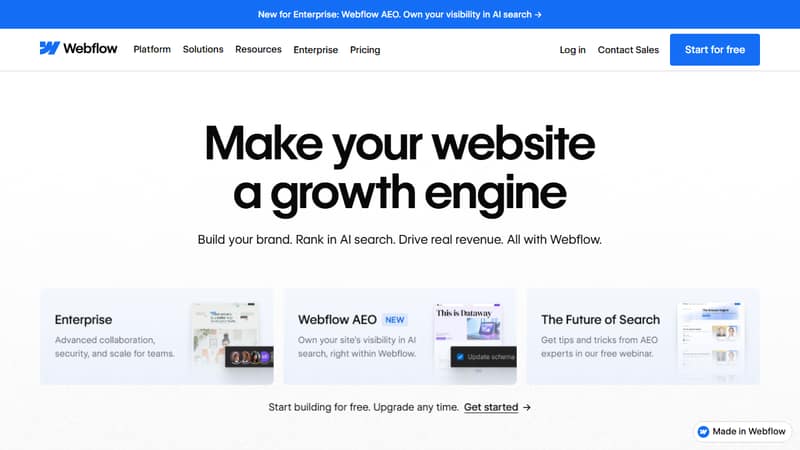
Both tools, on screen
| Framer | Webflow |
|---|---|
 |  |
| framer.com | webflow.com |
Real screenshots of both homepages in May 2026, unretouched.
Who should pick Framer
You go with Framer if high-end design sites, AI generation and translation matches your actual need and freemium, with a paid tier at $9/month fits your budget. It's for profiles who want to move fast, ship a product, without necessarily coding.
Who should pick Webflow
You go with Webflow if pro visual site builder, AI features added describes what you're looking for and freemium, with a paid tier at $17/month works for you. It's for profiles who want to move fast, ship a product, without necessarily coding.
The real cost over 12 months
At the monthly starting rate, over a full year: Framer costs $108, Webflow costs $204. The gap is $96 over 12 months, and it almost always doubles if you push the tool beyond the base quota.
The real question isn't "which one is cheaper" — it's "does Webflow deliver $96 more in value for your actual, concrete usage." Without a hard answer to that, Framer is the rational default.
The 2026 context
The AI no-code category is moving fast in 2026, and choosing between Framer and Webflow isn't just about price or features. Three underlying forces are shaping the market.
First, the big models are swallowing wrappers. Any tool whose value sits in a system prompt or a UX layer on top of an LLM is exposed: Claude, GPT, and Gemini are integrating these functions natively with every release. That's exactly what the Joute verifiability score is about: it flags the tools that resist this dilution.
Second, pricing is getting murky. Credits, tokens, quotas, tiers: the price shown on the pricing page is rarely the real cost in practice. That's true for both tools here, and it's why we document the annual cost above.
Third, the market is going European. Vendors are integrating French language support, euro billing, and GDPR compliance. On both Framer and Webflow, check where your data is hosted before committing at an enterprise level.
Traps to avoid
Three recurring mistakes when choosing between these two tools, regardless of which one you end up picking.
Comparing the entry price and forgetting the total cost. The monthly ticket shown is almost always the lowest tier, calculated on annual billing. On monthly billing, that's 15 to 25% more. And with quotas getting eaten up, budget 1.5 to 2× the listed price for daily pro use.
Making the call based on a demo. Every AI tool vendor knows how to put on a slick demo. The only metric that counts is your real usage over two weeks of normal work. All serious tools have a free trial: use it on a real task, not the demo's perfect use case.
Ignoring the ecosystem. An isolated tool is worth less than a well-integrated one. Before choosing, check native connectors (Slack, Notion, GitHub depending on your stack), API quality, and the extensions community. Framer and Webflow have different ecosystems, and that's often what tips the decision at 12 months.
Verdict by profile
If you're new to the category. Webflow is the safe default: gentler learning curve, more complete English documentation, more active community on forums.
If you already have your stack. First look at how well it integrates with your existing tools. Framer and Webflow have different ecosystems, and that's often what actually tips the decision in practice.
If you're building for a team. Beyond the raw score, look at team pricing, SSO management, and admin controls. The solo rate is only part of the equation — the annual cost per user can double between tiers.
Verdict
Webflow wins this duel. Webflow is our pick here. The loser isn't bad — it just targets a narrower use case or carries a hidden cost that Webflow avoids.
To dig deeper, check out the AI no-code category or open the comparator to pit them against each other on your own criteria. You can also check the detailed pages: Framer and Webflow.
Frequently asked questions
Framer or Webflow for beginners?
Webflow, because for the majority of use cases. Framer is a solid plan B for profiles that fall outside the majority case (vibe coders, rapid prototyping).
Which one is cheaper in real use?
Webflow has the lowest entry ticket. But at heavy usage, quotas get eaten up fast on both: budget double the listed price if the tool runs every day.
Can you use Framer and Webflow together?
Often yes, as long as the use cases complement each other. Framer and Webflow are in the same category (AI no-code) so there's overlap, but if you're switching between slightly different use cases, a subscription to both isn't crazy.
Is Framer free?
Freemium: there's a limited free tier, and the paid subscription starts at $9/month to lift the limits.
Is Webflow free?
Freemium: there's a limited free tier, and the paid subscription starts at $17/month to lift the limits.
Winner: Webflow
pour la majorité des usages.